The mountain that was sea
There is limestone on the summit of Everest. 470 million years ago it was seabed, and trilobites lived in it. Then India began to move north. It travelled more than six thousand kilometres until, 40–50 million years ago, it collided with Asia. The land had nowhere to go. Only up. And the mountains are still growing.
We crossed the Kali Gandaki by bus. Fossil ammonites are found in its valley. Hindus call them shaligrams and keep them at home as living gods. Sea, mountain, river, god. All one and the same stone.
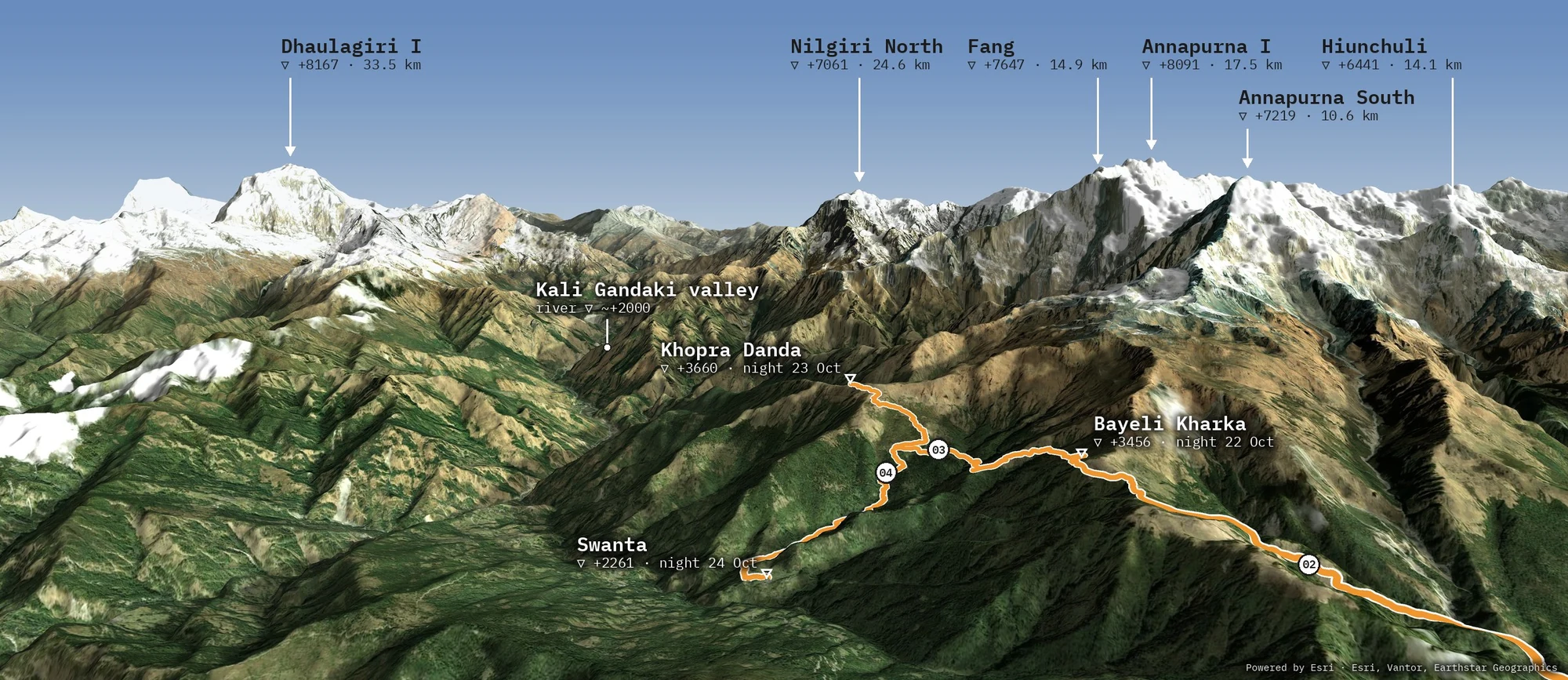
Maybe that is why the mountain calls. It does not ask who you are. In its time a human life is a single breath. On Khopra I stopped to rest because I had to. The mountain was not against me. It simply made no exception for me. The porter, the guide, the musk deer and I breathed the same air.
That is the equality. Before the mountain there are no big and small people. There is only a small person. And that does not hurt. It sets you free.
At Pashupatinath the ashes go into the Bagmati. The Bagmati carries them to the Ganges, and the Ganges to the ocean. Lime settles on the ocean floor. Perhaps some land will lift it up under the sky again one day.
The mountain was sea. The sea becomes mountain. In this circle I am a single breath.
The whole journey
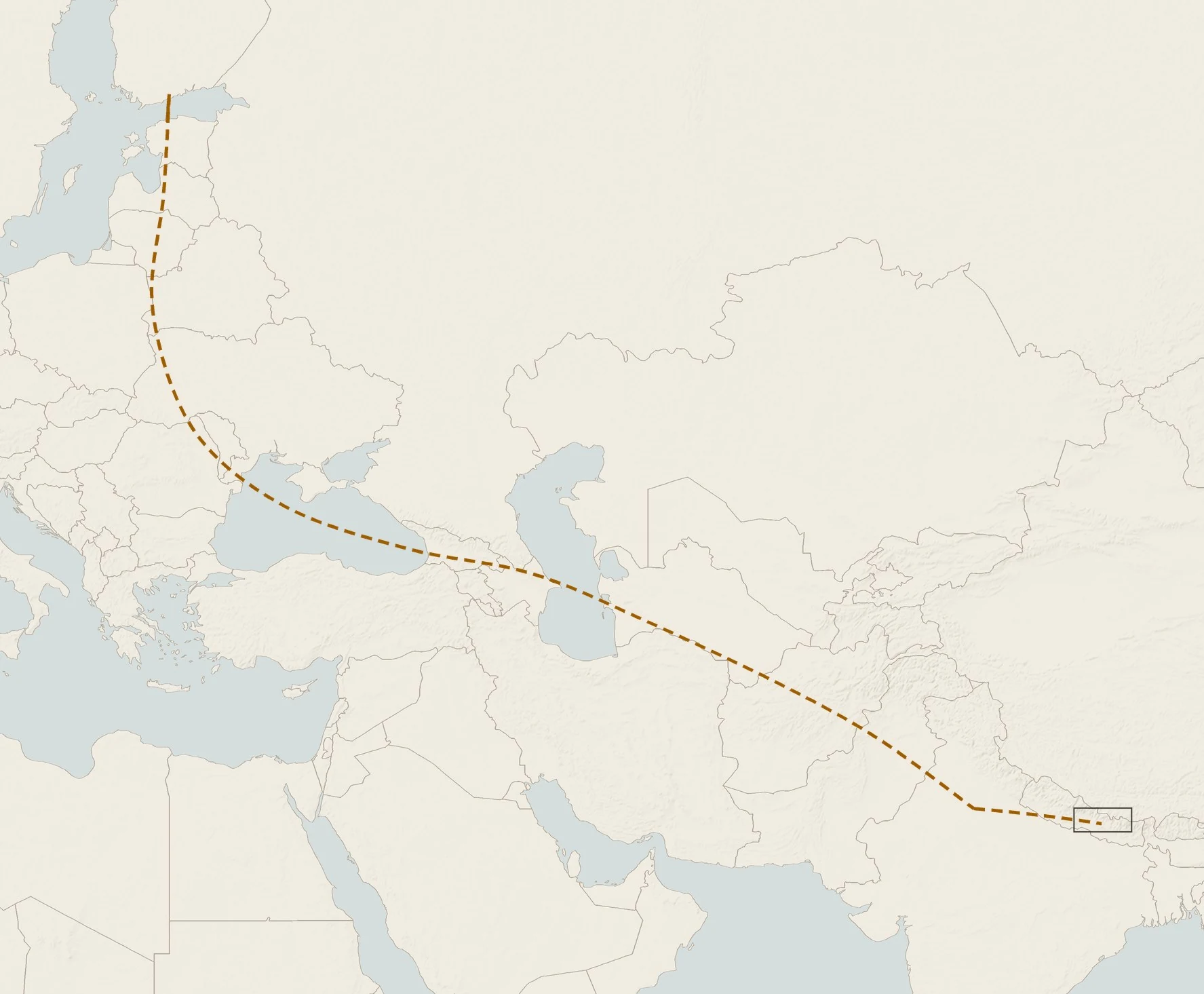
I started writing these lines over Georgia and I finish them over Turkmenistan, flying home. In between there was doubt whether this trip would happen at all. Mudslides tore up the roads, and Nepal seemed further away than the map showed. It happened anyway. We changed only one thing: we flew instead of taking the bus.
Kathmandu welcomed us with Dashain. In front of Kaal Bhairav there was blood on the stone. The next morning the same banana seller who had walked into my camera the day before was looking for a better spot to pose. Sacrifice and everyday life go side by side here. Nobody sees a contradiction in it.
In Pokhara we left our city clothes at the hotel. You have to leave something behind to go forward. At the time I did not know how literally that would come true.
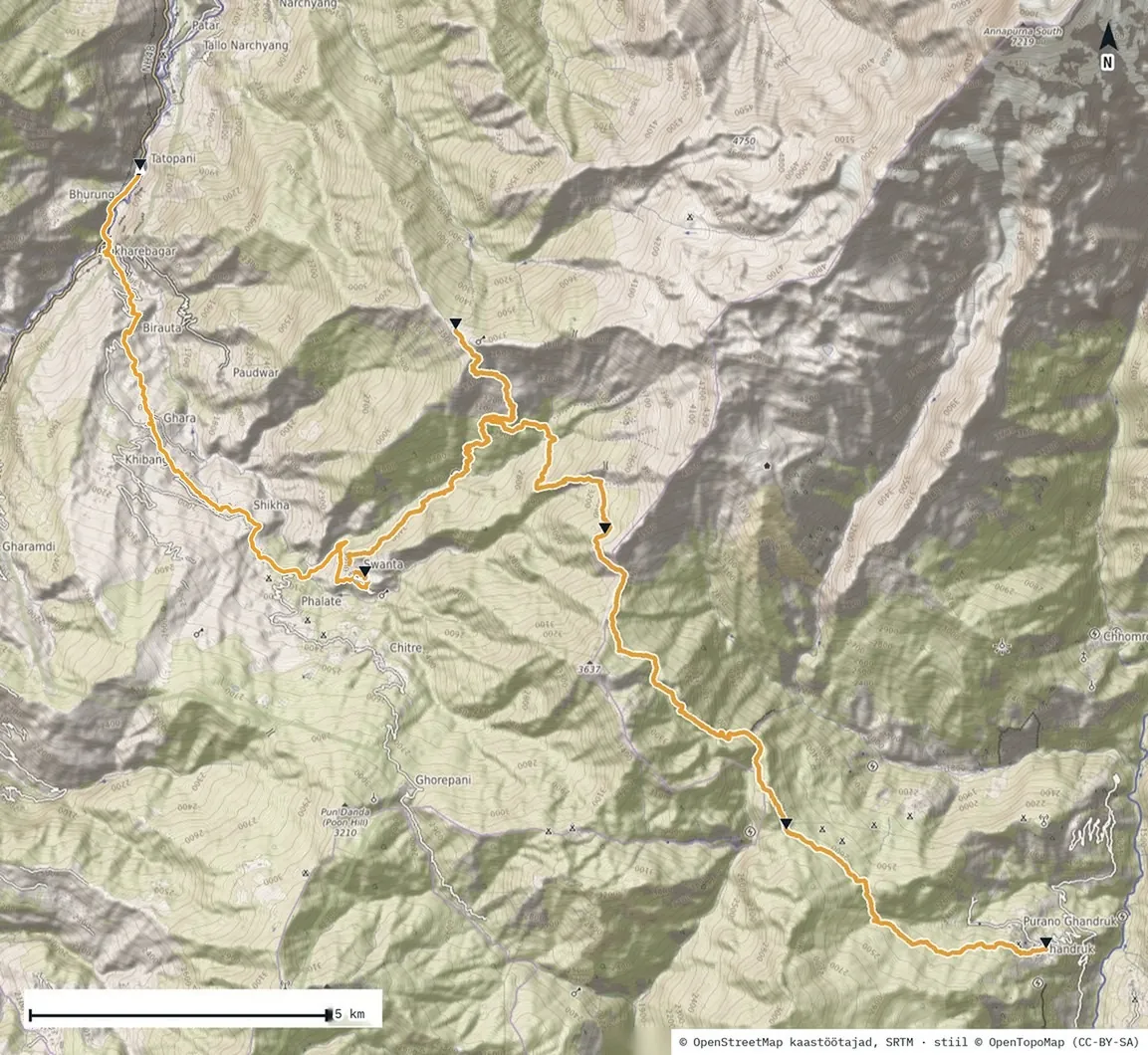
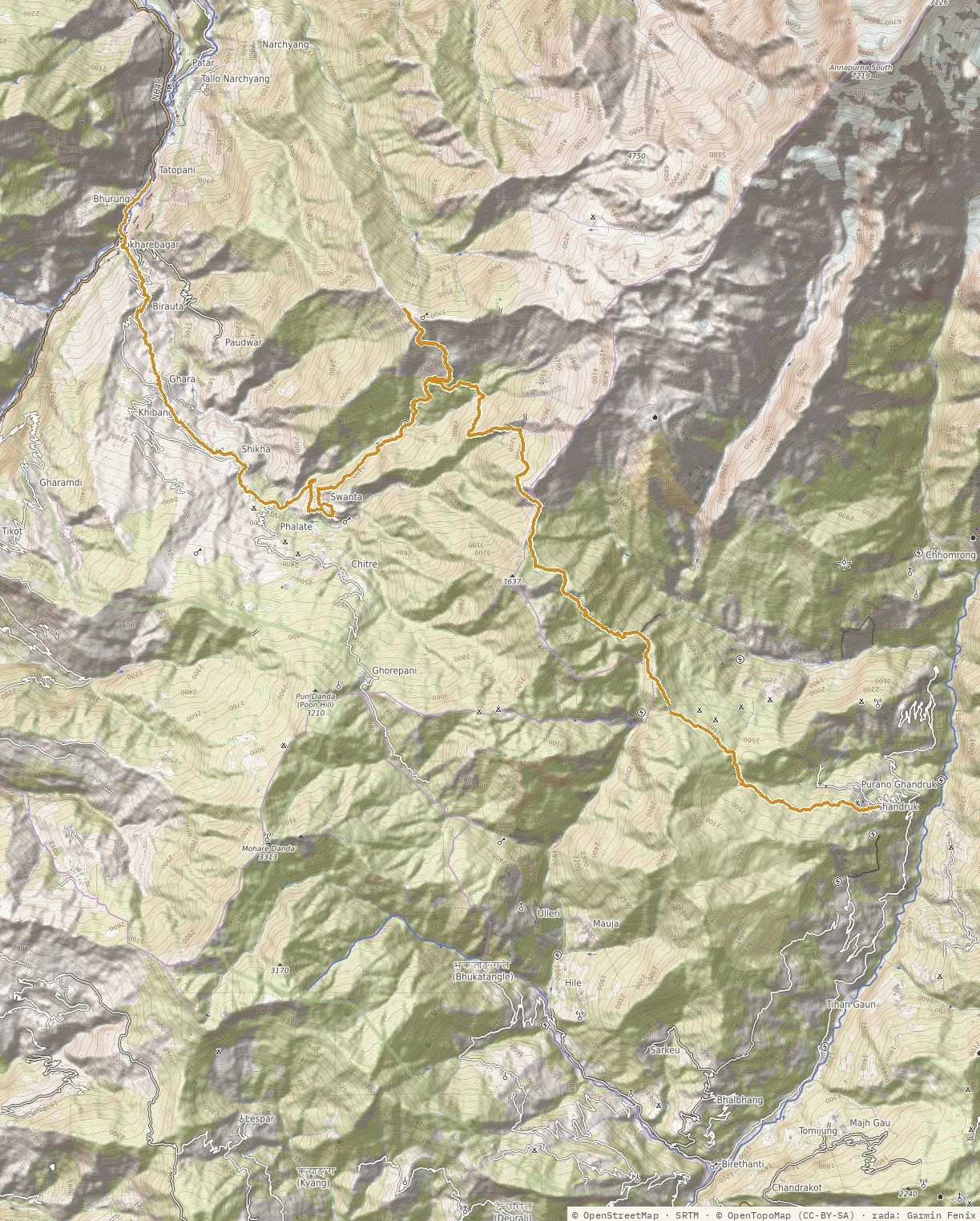
The mountains took away things you do not notice at home. Hot water. Bottled water. Part of the oxygen. On Khopra, at 3,660 metres, I stopped to rest because I had to, not because I wanted to. The body did not ask permission. My resting pulse rose from 52 to 58 and my blood oxygen fell to 92 per cent. In five days we covered 47.6 kilometres, three kilometres up and almost four down. The numbers are exact. What they meant I understood only in Swanta, when I turned on the tap and the water was warm.
Mountains are big and everyone sees them. A small thing you only see once it has been taken from you for a while.
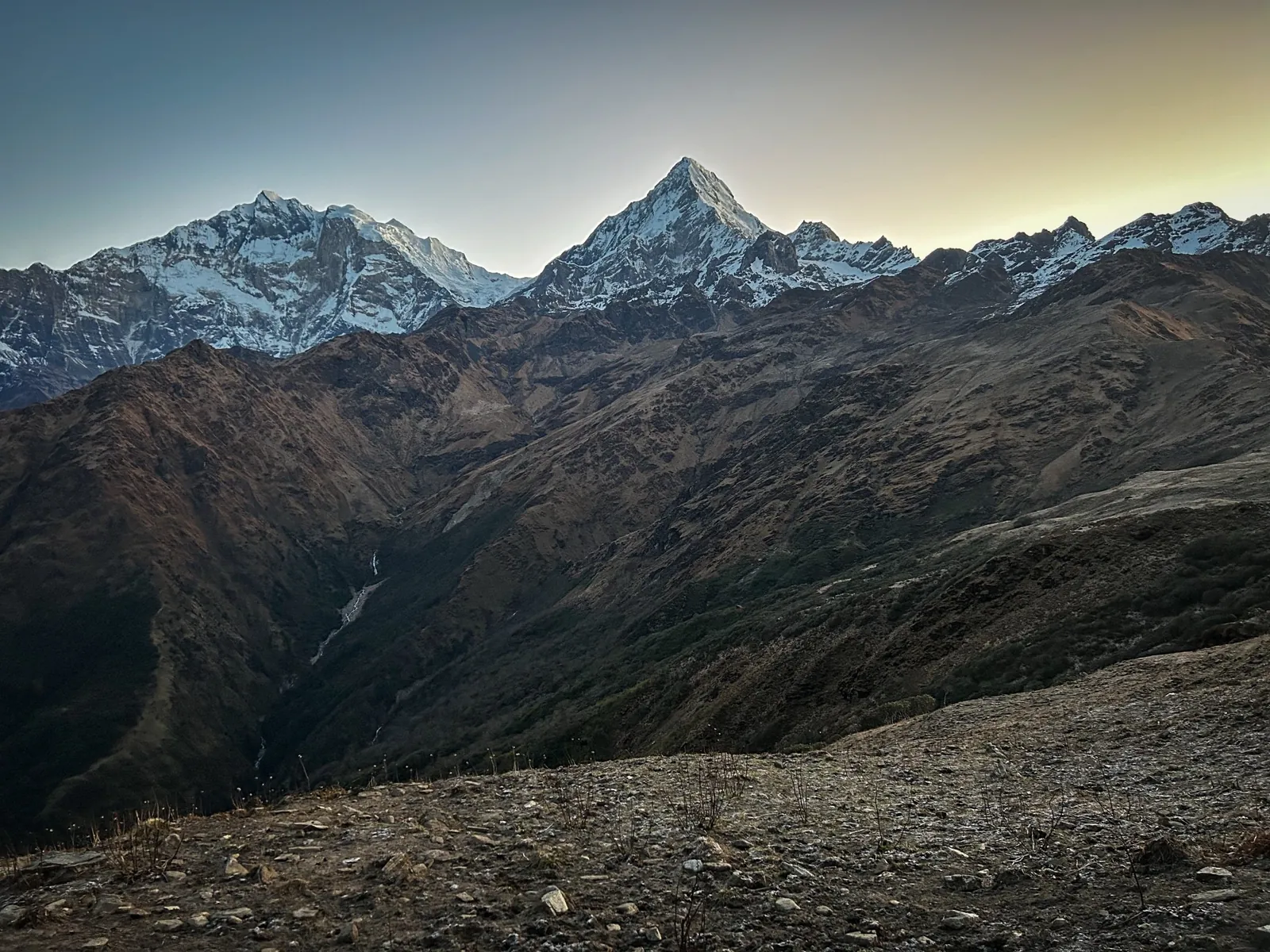
Nobody on the trail was in a hurry. Women washed clothes and herded children, and time stood still. A musk deer bounded away from me in the dusk, one of the roughly three thousand left in Nepal. Dhaulagiri watched over our sleep. To the mountains we were nothing special. And that felt good.
On the dance ground in Swanta we learned a lesson no guidebook writes: come and visit, dance along, but do not push your own culture on others. In Tashiling we met people who have waited more than sixty years to return to their homeland. As a man from southern Estonia I can understand that waiting a little. And when a dog with big ears came up beside my lassi and lay down at my feet, the only question left was whether it was a sign.
In Kathmandu the circle closed. At Boudha people walk clockwise around the stupa. On the wheel of life the god of death, Yama, holds the wheel, and outside its rim the Buddha points to the moon: there is a way out of the wheel.
On Wednesday morning we saw Everest. At first, mountains like any other mountains. Only from the photos did I understand what I had seen. In the afternoon we stood on the ghats of Pashupatinath and watched one journey end while an ambulance brought the next. The highest point on earth and a person’s last moment fitted into the same day. Nobody drew a line between them.
On this trip I said one sentence three times. To Muku, when he came to see us off at the hotel. To Pokhara, on my last walk through the night. And to Everest, through the aircraft window. I would like to meet again.
Muku said: Relax, take it simple. In the mountains every day had a clear shape. There was a trail to walk, a rest you needed and an evening to reach. At home that shape gets buried under calendars and notifications. But now I know where to look for it.
Delhi was the loudest part of the circle. Driving out of the airport made us gasp at the infrastructure; in the centre the road officially had three lanes, in practice five or six. In the evening I stood in the rain on the bridge over New Delhi railway station, feet soaked, and looked at the mass of tracks below me. Half a million passengers a day. I was not ready for it. But I was there.
The next day we were in the garden of Humayun’s Tomb, where a lotus blooms in the middle of the six-pointed stars on the gates and several faiths fit into a single stone ornament. A couple of hours later we were in the mud of Old Delhi, children hanging on our arms. The sacred and the everyday went side by side again, as they had in front of Kaal Bhairav. The rickshaw driver waited until we had gone. That is a good way to leave, so that you come back.
Flying home I understood where the centre of my circle is. Not on a mountain.
My motto is: tomorrow I will be wiser than today, but today I am braver than tomorrow. Nepal made me wiser. That is why the next trip should not be left for tomorrow.